Cannabinoids: Why Does the Plant Make Them?
· Maarten Casteleijn

Cannabinoids are usually discussed in terms of their effects on humans, but those effects do not explain why Cannabis produces them. The plant invests carbon, energy and specialised tissues in their production, and experimental evidence supports a role in defence against chewing herbivores.
Other proposed functions, including UV protection and antimicrobial defence, remain less directly established in the ecological context of a living Cannabis plant. Understanding cannabinoid biology therefore requires separating demonstrated effects from plausible explanations.
Living Cannabis primarily produces acidic cannabinoids
Living Cannabis plants primarily produce acidic cannabinoids, including THCA, CBDA, CBCA and CBGA. Fresh material from a high-THC cultivar consequently contains mainly THCA rather than the neutral THC commonly discussed in relation to human effects.
Heat, storage and ageing can cause decarboxylation, the removal of a carboxyl group. This converts THCA to THC, CBDA to CBD and CBCA to CBC. The forms predominantly produced by the living plant are therefore not necessarily the same forms present after heating or prolonged storage.
Where are cannabinoids produced?
Cannabinoid production is concentrated in the glandular trichomes covering female inflorescences. Their secretory disc cells contain specialised metabolic machinery, with two biochemical pathways supplying components that converge in cannabinoid biosynthesis.
Olivetolic acid combines with geranyl pyrophosphate, or GPP, to form cannabigerolic acid, CBGA. Different cannabinoid synthases then convert CBGA into compounds including THCA, CBDA and CBCA. CBGA thus serves as a central precursor connecting several cannabinoid pathways.
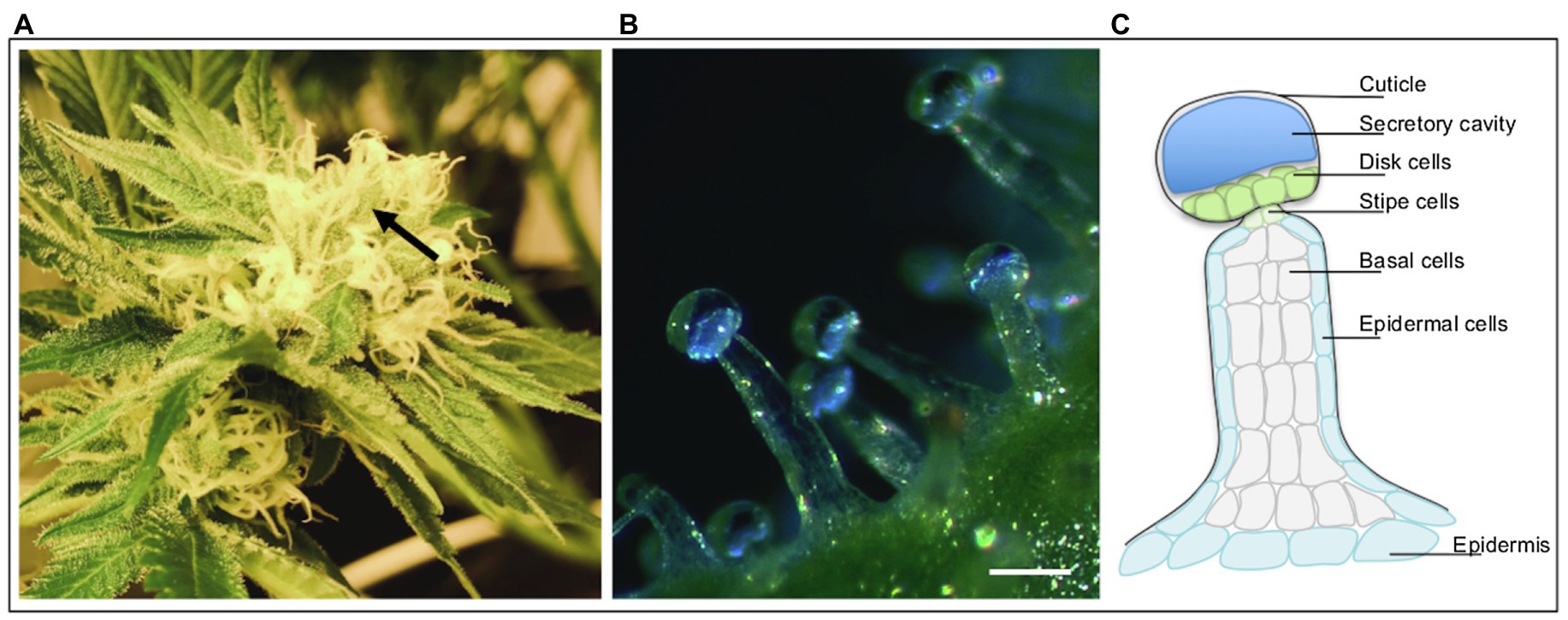
Figure 1 from Tanney, Backer, Geitmann & Smith (2021), Cannabis Glandular Trichomes: A Cellular Metabolite Factory. Reproduced without modification under CC BY 4.0. The same figure is used as this article's featured image.
Cannabinoid synthesis and storage are compartmentalised
Secretory cells manufacture precursors, while important later reactions occur towards the cell wall and extracellular storage cavity of the glandular trichome. The resulting cannabinoids accumulate in the resin-filled cavity above the secretory cells.
These structures combine specialised metabolism with extracellular storage. Their anatomy helps explain how Cannabis produces and accumulates large quantities of biologically active compounds, although anatomy alone does not establish the ecological function of every compound.
Cannabinoids cost the plant resources
Cannabinoid production requires carbon fixed through photosynthesis, energy, enzymes and the development of trichome tissues. It also uses precursor molecules that could participate in other metabolic processes.
This investment makes the biological benefits an important research question. The amount invested does not by itself identify a specific evolutionary function; ecological experiments are needed to test proposed benefits.
Direct evidence for defence against chewing herbivores
UV protection, antimicrobial activity and herbivore defence have all been proposed as functions of cannabinoids, but direct ecological evidence was historically limited. Stack and colleagues (2023) tested the herbivore hypothesis using a segregating Cannabis population with different cannabinoid concentrations.
In the field, foliar cannabinoid concentration was inversely associated with chewing damage. In detached-leaf assays, caterpillars consumed less tissue and grew less on leaves with higher cannabinoid concentrations.
The researchers also added cannabinoids to artificial insect diets to separate their effects from other features of the plant. Increasing cannabinoid concentrations reduced larval growth and survival. This provides stronger evidence of an effect of the compounds themselves than the field association alone, while remaining specific to the herbivores and conditions tested.
Biological activity can contribute to defence
Compounds that deter feeding, reduce growth or disrupt the physiology of a herbivore can contribute to plant defence. The insect experiments support such a role for cannabinoids without establishing that all cannabinoids affect all herbivores in the same way.
Their effects on human physiology are a separate question. A demonstrated defensive effect also does not, by itself, reconstruct the evolutionary history of the pathway or establish defence as its only function.
Why protect the flowers so strongly?
Female Cannabis flowers have high densities of cannabinoid-producing glandular trichomes. Concentrating defensive chemistry around reproductive tissues is consistent with the importance of flowers and developing seeds to reproduction.
This is a plausible ecological interpretation of their distribution rather than direct proof of why every trichome occurs where it does. Modern selection for resinous female inflorescences has also influenced the traits seen in cultivated Cannabis.
Why store cannabinoids at the surface?
Glandular trichomes position resin at the interface between the plant and its environment, where a chewing insect can encounter it while attacking tissue. Extracellular storage also separates concentrated, biologically active compounds from much of the plant's cellular metabolism.
The structure therefore brings production, storage and potential contact with herbivores together. These anatomical features help explain how a defensive effect can operate, without implying that every external secretion has the same ecological role.
Do all cannabinoids do the same thing?
More than 100 phytocannabinoids have been described, although relatively few normally occur at high concentrations. Different synthases route CBGA into different products, and genetics strongly influences whether a plant predominantly accumulates THCA, CBDA, CBGA, CBCA or mixtures of these compounds.
This diversity is a reason not to treat cannabinoid function as a single, uniform phenomenon. Different molecules may have overlapping but distinct ecological effects, and the effect of a mixture cannot automatically be assigned to each component.
What about insects that suck rather than chew?
A chewing caterpillar consumes leaf tissue, whereas an aphid feeds through mouthparts inserted into vascular tissue. These different feeding strategies can change how an insect encounters glandular secretions and other plant defences.
MacWilliams and colleagues (2023) found lower fecundity, net reproductive rate and adult longevity of cannabis aphids on a high-cannabinoid cultivar than on a low-cannabinoid cultivar in whole-plant assays. In contrast, 1 mM CBD in an artificial diet increased aphid fecundity during days 1–3, with no significant effect on adult survival. The solvent controls also mattered because DMSO affected aphid performance.
The whole-plant result therefore does not establish CBD alone as the cause of reduced aphid performance. Cannabinoids, terpenes, flavonoids, physical trichomes and inducible defence responses form a more complex system than an isolated-compound feeding assay.
Cannabinoids and terpenes occur in the same resin
Cannabinoids accumulate alongside terpenes in glandular trichomes. Terpenes can participate in plant defence and ecological signalling, with the evidence and functions differing between compounds and plant systems.
It is therefore useful to consider the resin as a mixture rather than divide its biology into commercial categories of potency and aroma. Co-occurrence does not prove a shared function or synergy; the contribution of each component needs to be tested in relation to genotype, herbivore and environment.
What about UV protection?
Cannabis glandular trichomes occur on exposed surfaces, and many plant specialised metabolites can protect tissues against excessive radiation. Cannabinoids have consequently been proposed to contribute to UV protection.
The herbivore study identifies UV and pathogen protection as longstanding hypotheses while noting the historically limited direct ecological evidence. A plausible role in radiation responses is not equivalent to proof that Cannabis produces THC primarily for UV protection.
What about pathogens?
Cannabinoids show antimicrobial activity in laboratory studies, making pathogen defence another plausible function. Inhibiting a microorganism in vitro does not automatically demonstrate protection in a living flower.
Experiments testing whether changes in cannabinoid concentration alter infection outcomes under realistic conditions would provide stronger evidence of ecological protection. Even such results would need to be distinguished from a complete explanation of the pathway's evolutionary origin.
Why does stress affect cannabinoids?
Environmental stress can alter photosynthesis, hormone signalling, carbon allocation, defence pathways and reproductive development. Cannabinoid concentrations can consequently respond to growing conditions.
It does not follow that deliberately stressing a plant will increase THC production. Stress can reduce growth, flower biomass or cannabinoid synthesis, and a concentration increase may occur alongside a decrease in biomass. Responses depend on stress type, severity, timing and genotype. Does Stress Increase THC or Terpenes? examines these distinctions in more detail.
Concentration is not production
Consider a hypothetical plant producing 100 g of flower at 20% cannabinoids, equivalent to 20 g of cannabinoids. A stressed plant producing 60 g at 22% contains 13.2 g. The second plant has the higher concentration but the lower total cannabinoid yield.
These figures are an illustration, not results from a particular treatment experiment. They show why both concentration and biomass are needed to evaluate production. Raising a percentage while substantially reducing flower yield is not necessarily an improvement.
Cannabinoids are specialised metabolites
Cannabinoids belong to plant specialised metabolism, historically often called secondary metabolism. These compounds can be important to interactions with the environment even though the term “secondary” may suggest otherwise.
Other examples include capsaicinoids in hot peppers, nicotine in tobacco, glucosinolates in brassicas, caffeine in coffee and specialised terpenes in many species. Different lineages have developed different chemistry associated with ecological interactions; these examples do not imply identical functions or mechanisms.
Why Cannabis?
Cannabinoid biosynthesis combines a polyketide-derived component with an isoprenoid component supplied by pathways already present in plant metabolism. These pathways converge to form CBGA, from which major cannabinoid families develop.
The pathway illustrates how specialised chemistry can arise through modification and integration of existing metabolic processes. Cannabis also has specialised enzymes and glandular structures associated with this chemistry, while other plant lineages have developed different metabolic combinations.
Human selection has changed cannabinoid profiles
Selective breeding for particular cannabinoid profiles and resinous inflorescences has substantially influenced cultivated Cannabis. Claims about modern flowers containing 25–30% “THC” should also be interpreted in light of analytical reporting and the predominance of acidic forms in fresh material.
The ecological origin of cannabinoid production and the high concentrations selected in modern cultivars are therefore different questions. The first concerns the evolution and function of the pathway; the second also involves human selection over cultivation history, intensified by modern breeding.
The bigger picture
Cannabis produces cannabinoids through specialised metabolism associated with glandular trichomes, particularly around female reproductive tissues. Field observations, detached-leaf assays and artificial-diet experiments support a defensive role against chewing herbivores.
That evidence supports defence as part of the explanation for cannabinoid function, not an exclusive purpose for every cannabinoid. UV protection, antimicrobial activity, effects on other herbivores and interactions within the resin mixture require their own evidence. Their possible effects on humans remain distinct from these plant functions.
References
Stack, G.M. et al. (2023). Cannabinoids function in defense against chewing herbivores in Cannabis sativa L. Horticulture Research, 10, uhad207. https://doi.org/10.1093/hr/uhad207.
Xie, Z. et al. (2023). Cannabis sativa: origin and history, glandular trichome development, and cannabinoid biosynthesis. Horticulture Research, 10, uhad150. https://doi.org/10.1093/hr/uhad150.
Hancock, J., Livingston, S.J. & Samuels, L. (2024). Building a biofactory: Constructing glandular trichomes in Cannabis sativa. Current Opinion in Plant Biology, 80, 102549. https://doi.org/10.1016/j.pbi.2024.102549.
Romero Betancourt, J.D., Sarmiento, F. & Germain, H. (2026). From Model Plants to Cannabis: Genetic Regulation of Glandular Trichome Development. Plants, 15(18), 2810. https://doi.org/10.3390/plants15182810.
Tanney, C.A.S., Backer, R., Geitmann, A. & Smith, D.L. (2021). Cannabis Glandular Trichomes: A Cellular Metabolite Factory. Frontiers in Plant Science, 12, 721986. https://doi.org/10.3389/fpls.2021.721986. Figure 1 reproduced under CC BY 4.0.
MacWilliams, J., Peirce, E., Pitt, W.J., Schreiner, M., Matthews, T., Yao, L., Broeckling, C. & Nachappa, P. (2023). Assessing the adaptive role of cannabidiol (CBD) in Cannabis sativa defense against cannabis aphids. Frontiers in Plant Science, 14, 1223894. https://doi.org/10.3389/fpls.2023.1223894.